
Opinion
The Dark World You Do Not Want to Know Exists
Inside the social media machine that feeds Jew-hatred to millions, and why it never stays on the screen.

By Dvir Abramovich
Chairman, Anti-Defamation Commission
Listen to this column 9:35 · AI narration
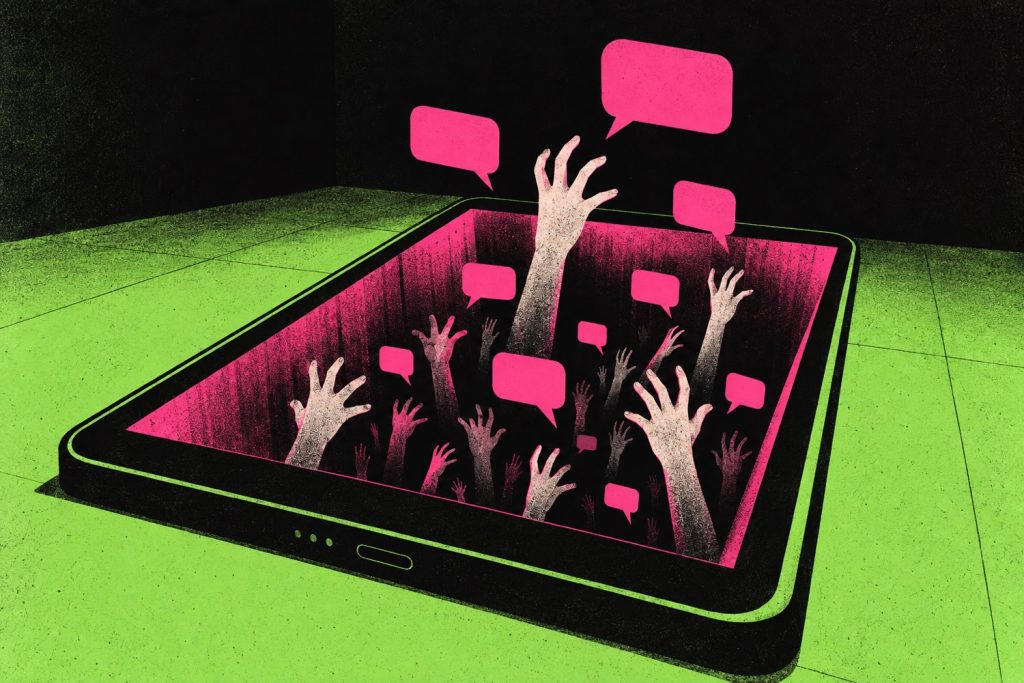
There is a sickness loose in the digital bloodstream, and it has a name: Jew-hatred. I have seen what lives in the sewer of social media, and I am telling you now that the stench is no longer staying underground. It is pouring through TikTok, crawling through Instagram, nesting inside Facebook and collecting ad revenue on YouTube, driven by an algorithm hungry enough to feed it to millions.
Social media did not invent Jew-hatred. It put it in every pocket, fed it to children, wrapped it in music, sold ads beside it and called the whole thing engagement.
October 7 was not only a massacre. It was a trapdoor. While Jewish families were still screaming, while bodies were still being identified, while the raped, burned, murdered and kidnapped were still being counted, the internet was already doing what it always does to Jews. It doubted them. It mocked them. It blamed them. It asked if the dead were real, if the blood was staged, if the victims were actors, if the whole thing was another “false flag”
That is the underworld I am talking about. A place where Jewish pain has to prove itself before it is believed. A place where Jewish death is treated as content. A place where the Jew is never allowed to bleed without someone online accusing him of holding the knife.
After October 7, YouTube’s comments did not get worse. They blew open. In the first three days after the slaughter, anti-Jewish replies on conflict videos jumped by almost 5,000 per cent. More than 15,000 antisemitic comments were identified after the attack. The hostages were still in Gaza, and the threads were already vomiting the same buried slanders.
Bondi has already told us the screen is not a cage.Dvir Abramovich
Scroll through that pit and you will find the whole museum of Jewish hatred, every exhibit polished for the digital age. The Rothschild fantasy. The Khazar lie. The “fake Jews” fraud. The “Synagogue of Satan” sickness. Holocaust denial. Holocaust distortion. Blood libels. “Zionist” control myths. October 7 denial. Jewish money. Jewish power. Jewish evil.
Nothing is new. That is the horror of it. The ancient delusions did not die. They were resized for a phone screen.
TikTok is where the gutter learned to dance. It is where Jew-hatred gets music. It is where invective arrives with stickers, sounds, coded hashtags, slang and jokes children can understand before they understand history. The platform can look like make-up clips, recipes and dance videos, and then, with a few clicks, the floor opens and you are falling into “fake Jews”, “Ashkenazi witchcraft”, satanic ancestry, Khazars, secret banking families and “Zionist schemes”.
This is how the trap works. You do not need to search for the darkness. The darkness is suggested. The darkness is recommended. The darkness slides into the feed between everyday things, as if Jewish devil-worship belongs beside a video about scrambled eggs.
One antisemitic TikTok slideshow, set to “Hava Nagila” drew more than 187,000 likes and 7,000 comments. A Jewish song became background music for anti-Jewish filth. The crowd did not stumble on it. It applauded it.
At Australia’s Royal Commission, TikTok heard about a case where its own AI reportedly flagged antisemitic content, only for human moderators to let it back on the platform after appeal. It was reviewed again. Still no violation. Only after further escalation was it removed, with TikTok later saying it “absolutely” breached its rules. Sometimes the machine sees the venom before the humans do.

Instagram makes Jew-hatred look harmless. That is its danger. A Pesach greeting goes up, and the replies become a toilet. A Jewish creator posts about cooking, singing, prayer or family, and suddenly the thread is full of slurs, Nazi vitriol, “Zionist” bile and trolls spitting on Jewish grief. The hate does not need a hood anymore. It has a profile picture.
Then came the fake rabbis, a new kind of depravity, digital bodysnatching. AI-generated Jewish faces. Synthetic beards. Counterfeit holy men that never breathed, never prayed, never learned, never lived, suddenly speaking as if they were Jewish authorities. On TikTok, a documented network of 49 bogus AI “rabbi” accounts had more than 950,000 followers and more than 10 million likes. On Instagram, similar phoney rabbis were used to push the same money-and-power conspiracies.
Facebook is the cellar where yesterday’s hatred is stored. Less glamorous. Less fashionable. Still lethal. It is where conspiracies ferment, where groups pass poison around like family recipes, where “Jew World Order”, “Jews control the media”, “Jews did 9/11”, “subhuman”, “Synagogue of Satan” and Holocaust denial can sit, spread and harden.
Do not be fooled because Facebook feels old. Old pipes still carry dirty water. In one investigation, antisemitic Facebook group administrators did not just fail to clean up hate. Some had posted anti-Jewish filth themselves. When hateful posts were flagged, the reporters could be punished while the savagery stayed up. Like handing the keys of the fire station to the arsonist.
YouTube is the paymaster. Jew-hatred as a revenue stream. It does not merely host the rot; it sells ads beside the bottle. In one review of 302 English-language antisemitic YouTube uploads, almost a quarter carried ads. The clips drew nearly eight million views. Fewer than 11 per cent were removed after being reported.
And somehow the machines can detect a stolen track in seconds. But when the Jew is the target, everyone becomes confused. If you want the local taste of this decay, look at the Bondi massacre.
The Royal Commission heard that Arsen Ostrovsky, a victim of the Bondi attack, reported a YouTube video that described him as an “intelligence asset” with a “degree in theatre”. The clip referred to a selfie showing his head covered in blood, while one person in the footage claimed he was wearing makeup. It was flagged multiple times. YouTube’s policy manager told the Royal Commission it had been reviewed at a high level and remained on the platform.
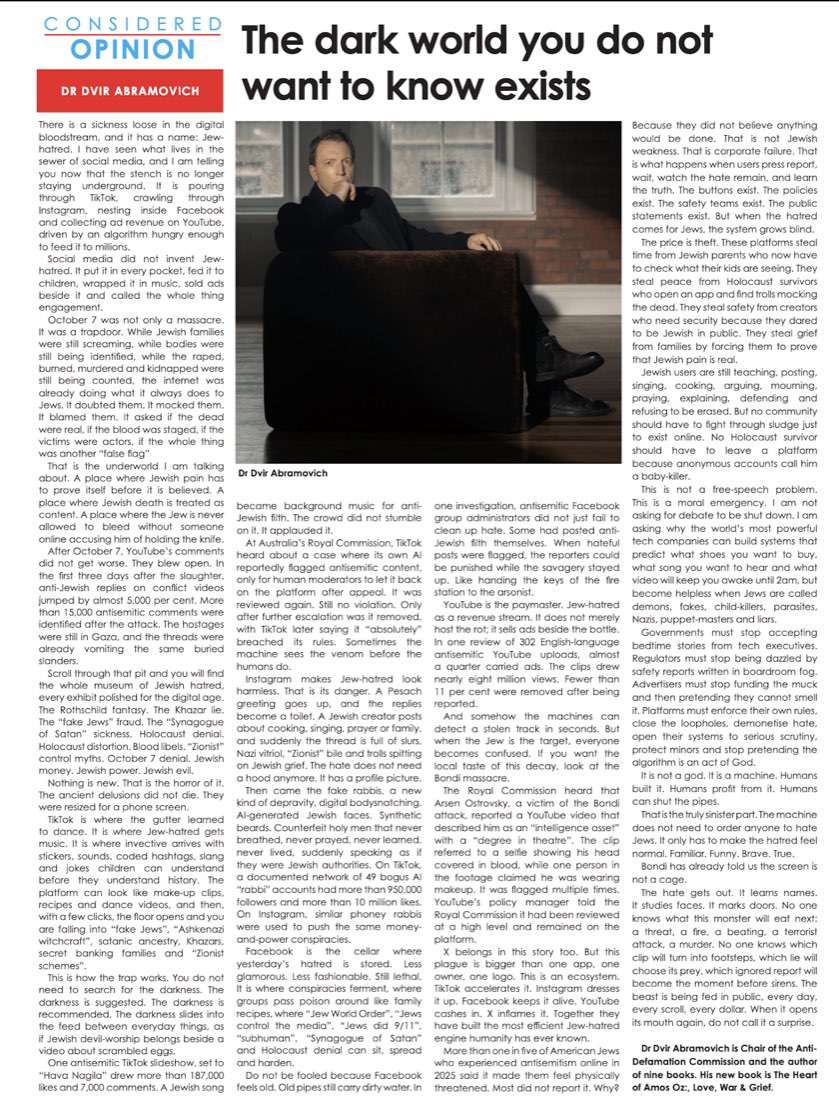
X belongs in this story too. But this plague is bigger than one app, one owner, one logo. This is an ecosystem. TikTok accelerates it. Instagram dresses it up. Facebook keeps it alive. YouTube cashes in. X inflames it. Together they have built the most efficient Jew-hatred engine humanity has ever known.
More than one in five of American Jews who experienced antisemitism online in 2025 said it made them feel physically threatened. Most did not report it. Why? Because they did not believe anything would be done. That is not Jewish weakness. That is corporate failure. That is what happens when users press report, wait, watch the hate remain, and learn the truth. The buttons exist. The policies exist. The safety teams exist. The public statements exist. But when the hatred comes for Jews, the system grows blind.
The price is theft. These platforms steal time from Jewish parents who now have to check what their kids are seeing. They steal peace from Holocaust survivors who open an app and find trolls mocking the dead. They steal safety from creators who need security because they dared to be Jewish in public. They steal grief from families by forcing them to prove that Jewish pain is real.
Jewish users are still teaching, posting, singing, cooking, arguing, mourning, praying, explaining, defending and refusing to be erased. But no community should have to fight through sludge just to exist online. No Holocaust survivor should have to leave a platform because anonymous accounts call him a baby-killer.
This is not a free-speech problem. This is a moral emergency. I am not asking for debate to be shut down. I am asking why the world’s most powerful tech companies can build systems that predict what shoes you want to buy, what song you want to hear and what video will keep you awake until 2am, but become helpless when Jews are called demons, fakes, child-killers, parasites, Nazis, puppet-masters and liars.
Governments must stop accepting bedtime stories from tech executives. Regulators must stop being dazzled by safety reports written in boardroom fog. Advertisers must stop funding the muck and then pretending they cannot smell it. Platforms must enforce their own rules, close the loopholes, demonetise hate, open their systems to serious scrutiny, protect minors and stop pretending the algorithm is an act of God.
It is not a god. It is a machine. Humans built it. Humans profit from it. Humans can shut the pipes.
That is the truly sinister part. The machine does not need to order anyone to hate Jews. It only has to make the hatred feel normal. Familiar. Funny. Brave. True.
Bondi has already told us the screen is not a cage.
The hate gets out. It learns names. It studies faces. It marks doors. No one knows what this monster will eat next: a threat, a fire, a beating, a terrorist attack, a murder. No one knows which clip will turn into footsteps, which lie will choose its prey, which ignored report will become the moment before sirens. The beast is being fed in public, every day, every scroll, every dollar. When it opens its mouth again, do not call it a surprise.
First published in The Jewish Report, August 2026.
Dr Dvir Abramovich is chairman of the Anti-Defamation Commission and the author of nine books. His latest publication is The Heart of Amos Oz: Love, War & Grief.