
Opinion
The Blood of Fifteen Australians Is on Every Page of This Report
An email warned police an attack was likely. Six days later, four officers guarded a thousand people. The royal commission lays it bare.
Chairman, Anti-Defamation Commission
Listen to this column 9:00 · AI narration
I was at home when the news broke, in the kind of forgettable moment that defines a country that still believes it is safe. There was nothing in the air that suggested horror was about to intrude, nothing to prepare you for the way a single message can fracture your sense of reality.
The phone lit up, a name appeared, and at first the words meant very little. Bondi. An incident. Shots. You read them once, then again, and then your body reacts before your mind catches up, because somewhere deep inside you already understand that something terrible has begun to unfold. The messages come faster now, sharper, heavier, harder to dismiss, and you feel the room change around you as if the walls themselves are listening. People are running. There are casualties. It's bad.
That was the night. Sleep, when it came, late and shallow. A few days later, the country had a number.
Fifteen people. Fifteen lives ended in the space of a night, at a Jewish festival that was supposed to be about light, about resilience, about continuity, about the stubborn refusal of a people to disappear. Fifteen stories that will never be finished. Fifteen empty places at tables where laughter should have returned the next day.
That is where this story begins. Not in the language of a report. Not in a list of recommendations. Not in the tidy architecture of systems and processes. But in the raw, human moment when ordinary life is shattered and replaced with something permanent and irreversible.
But promises do not stop bullets.
It is from that place that I have read the Interim Report of the Royal Commission into Antisemitism and Social Cohesion. I have read it once. I have read it twice. I have read it three times. By the third reading, I was no longer taking notes. I was angry.
I was angry because I had been waiting, like every Jewish Australian who picked up that document, for the page on which the unforeseen would reveal itself. The page on which a country would be told, in its own official words, that what happened at Bondi was a horror that no one could have prevented.
That page does not exist. This report does not shock with revelation. It wounds with confirmation. And confirmation, in this case, is worse than revelation, because confirmation strips away the one comfort that nations cling to in the days after the terror, the belief that no one could have known.
People knew.
Picture a Sunday afternoon at Archer Park, in Bondi Beach. Volunteers are setting up. There is a petting zoo for the children. There is a rock-climbing wall. Food stalls are preparing donuts, deep-fried in oil, because that is what you eat at the festival of light. The event is scheduled to begin at five. At seven, there will be speeches, and the lighting of a giant menorah, and dancing. Up to a thousand people are expected. The location, on the event flier, reads: Bondi Beach Park, near the Children's Playground.
That is what was happening at Bondi Beach on the afternoon of 14th December 2025.
Now move backwards. Six days. The eighth of December. An email is sent from the Community Security Group of New South Wales to officers of the New South Wales Police.
The email is not buried in jargon. The email speaks in the plainest possible English, and the words that matter are written, in capital letters, in the original.
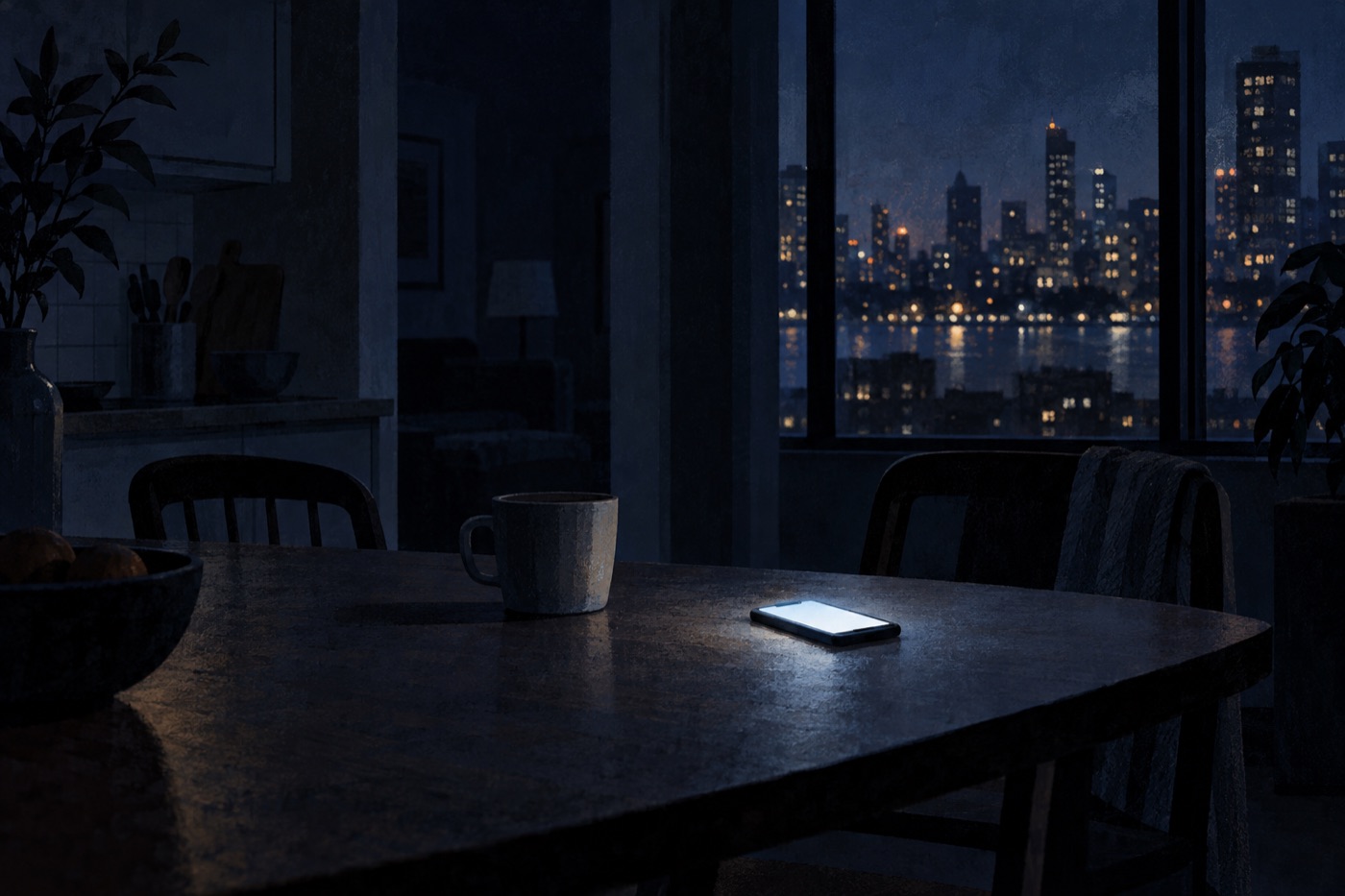
The current Security Level Alert for the NSW Jewish community is HIGH. A terrorist attack against the NSW Jewish Community is likely and there is a high level of antisemitic vilification.
Read it again. A terrorist attack. Against the NSW Jewish Community. Is likely.
This warning was sent to NSW Police. The email asked, in writing, for the deployment of police resources for the entirety of the event. Three days later, on 11th December, an internal NSW Police email was sent. From a NSW police inspector to the two inspectors who would be on duty at the festival on the night.
Seven words. "No need to stay the entire duration." I have read those seven words a hundred times. I have read them aloud to myself to hear how they sound in a human voice. I cannot understand how anyone, in possession of the email of 8th December, could read those words and put them in writing. But they were written.
They are now in a Royal Commission report, in the permanent record of this country. And on the night of 14th December 2025, three general duties officers and one supervisor were allocated to a Jewish festival that the community itself had begged, in writing, six days earlier, to be protected as a likely terrorist target. That night, two gunmen opened fire on the crowd.
Three officers. One supervisor. Four police, for a thousand people, at an event the country had been warned was in the bullseye.
But it would be a mistake to read this as the failure of one command on one night. The Royal Commission tells a far harder story. It tells us that for years before the attack, the country's national security apparatus had been stepping back from counterterrorism. By ASIO's 2022–23 reporting year, the federal intelligence agency had two branches working on counterterrorism, and five working on espionage and foreign interference.
The threat level was raised back to probable in August 2024. The Director-General of Security warned, in his own words, of a "disturbing escalation" in the targeting of Jewish interests. The community kept telling, kept writing, kept warning.
And the report makes one further finding so devastating it deserves its own line. There were no missing laws. There was no absent power. There was no legal obstacle preventing protective action. The system, as it existed in this country, had everything it needed to do what it was supposed to do. It simply did not do it.
The Prime Minister has now stood at a news conference and said that all of the report's recommendations relevant to the Commonwealth will be implemented in full. I want to believe those words.
But promises do not stop bullets. News conferences do not protect children at a menorah lighting.
Acknowledgements do not return one of the fifteen people who were murdered at Bondi Beach. What matters is whether anything visible, anything urgent, anything a Jewish parent can feel in their gut actually changes before the next Chanukah. The next Passover. The next Yom Kippur. The next time a thousand of us gather in a public park, lit by the candles of a festival that is, at its heart, a refusal to disappear.
And it is not just the Commonwealth's commitment that matters. The most consequential recommendations of this report, the ones that touch firearms, that touch policing, that touch the security of every public Jewish event in this country, will require the states and territories to act. Their commitment, too, will be measured against what we now know.
I am writing this for every non-Jewish Australian who has picked up this newspaper and is thinking that this is, somehow, someone else's story. It is not someone else's story. It is yours.
What happened at Bondi Beach happened in your country. The warnings that were ignored were ignored in your country. The 8th December email was sent in your country. The seven words – no need to stay the entire duration – were written, in your country, by an officer of your police force, in the week before fifteen of your fellow citizens were slaughtered.
The country that prides itself on safety, on fairness, on the fair go failed fifteen of its own. This is what the Royal Commission report says.
Antisemitism in this country is not a problem at the edges. It is not an academic debate. It is not a matter of perspective, or of nuance, or of being balanced.
It is a fire that has been burning, in clear public view, for more than two and a half years, while the institutions that promised to protect us looked at it and decided that it could be managed. It cannot be managed. It can only be confronted. There is no more time. The fifteen we lost at Bondi are how we know.
No one in this country gets to stand up tomorrow, or any day after, and say that what happened at Bondi was a tragedy no one could have foreseen.
The Bell interim report gives us an opportunity to act. To close the gap between warning and response. To ensure that when a threat is identified, it is met with the full weight of the system, without delay, without dilution, without the comfort of believing it will not go further. Because it does go further. It always does.
And now we know what the warning signs look like. We know the cost. Which means the next time those signs appear, the next time a community says it is at risk, the next time the threat level rises, every choice will carry a moral weight that cannot be ignored.
What happens next will define what kind of country this is. And whether Bondi was a turning point or a warning we will one day realise we failed to heed.
First published in The Jewish Report, 3 May 2026.
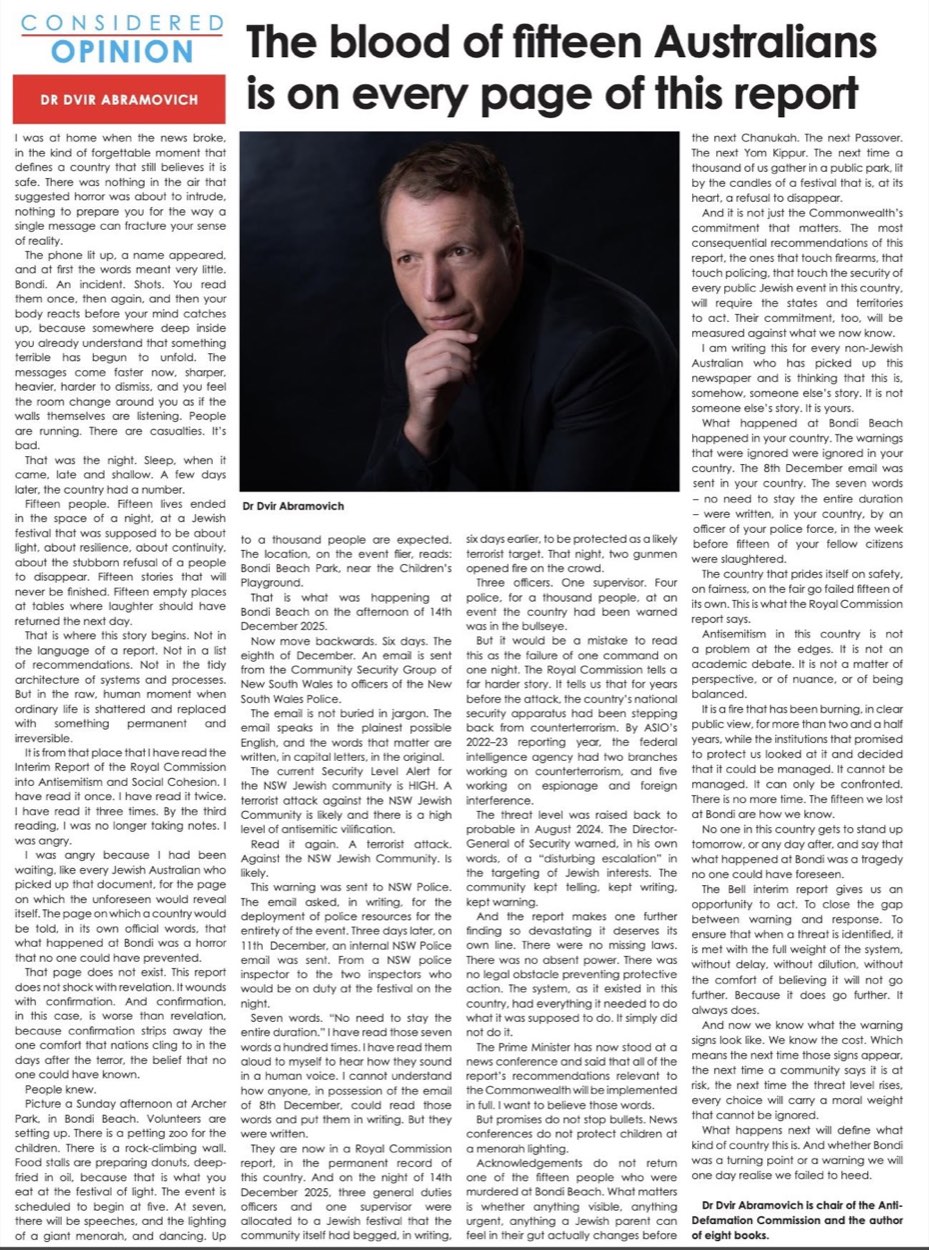
Dr Dvir Abramovich is chairman of the Anti-Defamation Commission and the author of nine books. His latest publication is The Heart of Amos Oz: Love, War & Grief.