

Opinion
The Bondi Massacre: The Day Our Idea of Australia Died
Two months on, the cameras have moved away, but the question Jewish Australians never wanted to ask remains: do we still belong here?

Chairman, Anti-Defamation Commission
Listen to this column 9:37 · AI narration
Nearly two months have passed and the pain still clings like a shadow that refuses to lift, a sorrow that coils tighter in the chest with every breath. When they gathered on Bondi that warm summer evening, they were not distant figures in a tragedy yet to unfold.
They came for a celebration, for connection, for the simple miracle of being together under an Australian sky. They were simply people – pulses quick with joy, souls open to the night, trusting in the gentle rhythm of Australian life. That trust is what was murdered first.
Fifteen people were slaughtered at Bondi on December 14 while celebrating Chanukah. Not killed. Slaughtered. I am done with polite language. Polite language is how we bury the dead twice, once in the ground and once in euphemism.
One of them was 10-year-old Matilda. Ten. An age meant for scraped knees and unfinished sentences. A child who should have outgrown her shoes, not her life.
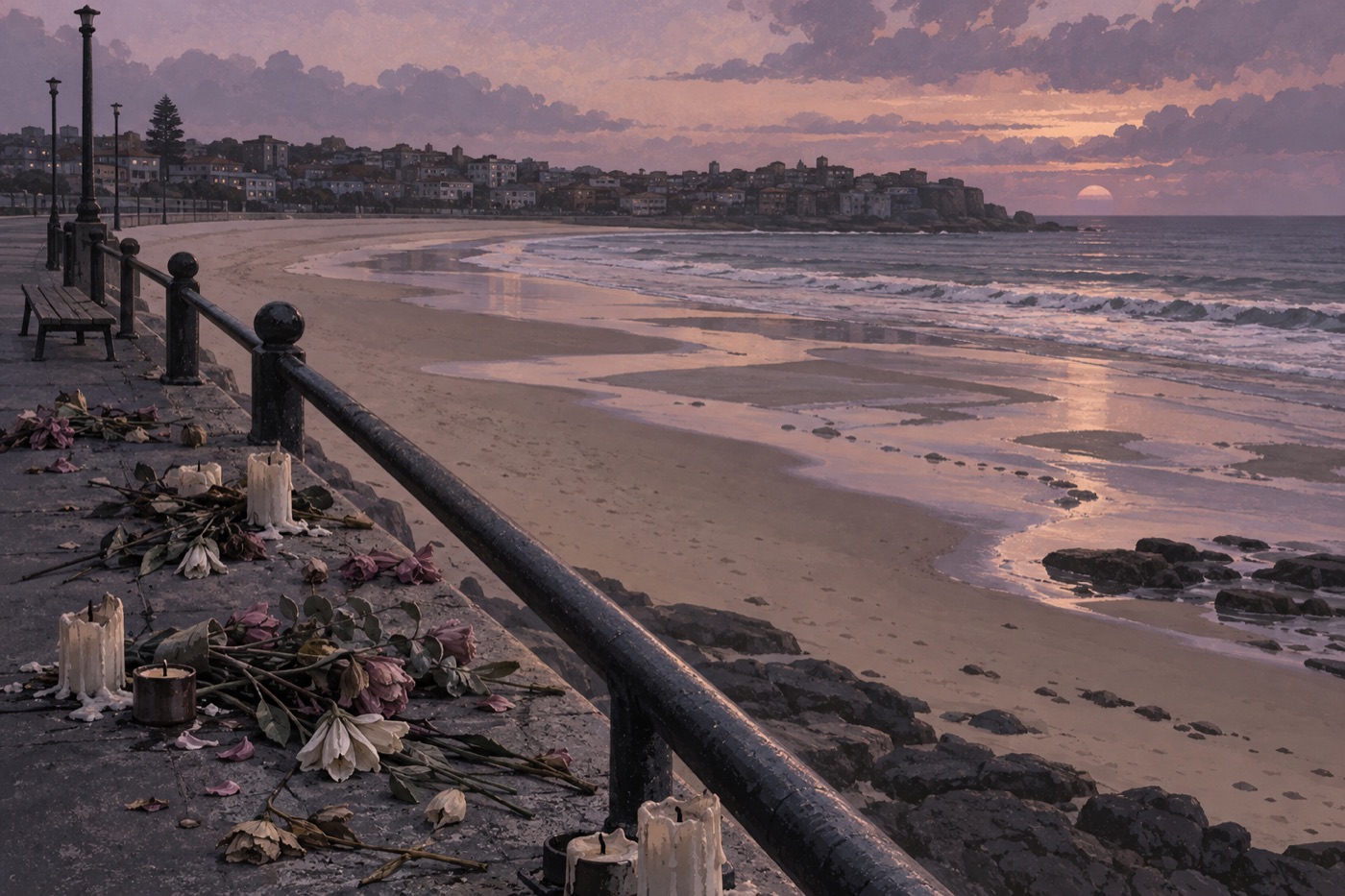
Picture her standing on that beach as the sun dipped low and the candles flickered against the evening breeze. The simple, precious wonder of being a child, free, unguarded, wrapped in the promise that this country would always keep her safe.
Polite language is how we bury the dead twice, once in the ground and once in euphemism.
The killers looked at her, a radiant, living miracle and saw a target.
They looked at a gathering of love and light and brought death to it. They looked at Holocaust survivors, rabbis, parents, grandparents, sons and daughters, and in that cold, merciless instant, they sentenced them to oblivion. Every victim who bled on that beach carried a world that vanished instantly: a voice that will never interrupt dinner again, a chair that will stay empty long after the flowers wither, a tomorrow erased so quickly we barely had time to say its name.
Australia now feels like a house many of us have lived in all our lives, where the walls are still standing, the windows still open, but certain rooms have changed shape while we were asleep. You can still walk through it. You just do it differently now. More carefully. More hesitantly.
That shift has hardened into a question Jewish Australians never wanted to ask out loud: Do we still belong here? Not as visitors. Not as tolerated guests on good days. But as full, equal citizens, able to stand in public as proud Jews without calculation.
I used to believe the answer was obvious. I believed Australia had learned something permanent from history. That cruel vilification, incitement to violence, dehumanisation and vicious bigotry must be met head-on, early, firmly, before it leads to carnage. Bondi shattered that faith.
British novelist and screenwriter Ian McEwan wrote something after September 11 that has never left me. He described the phone calls from the towers, of husbands calling wives, parents calling children, and strangers calling anyone who would answer. In those final moments, with death seconds away, what did they say?
Only love. That is what the victims carried in their last moments. Not ideology. Not politics. Love. For the people they would never see again. For the lives they would never finish living. For the ordinary future that was about to be obliterated.
The father and son could not acknowledge or imagine this. That is their monstrosity. Their evil made them incapable of understanding that every person they murdered was the centre of someone’s universe. That is what antisemitism does.
But Australians can imagine it. They must imagine it. Because if they refuse, if they let the slain become statistics, abstractions, last year’s news, they become accomplices to the forgetting.
Two months out, the cameras have moved on. The nation has returned to its regular business, as nations do, because horror is exhausting and normalcy is seductive.
This is how it always goes. The vigils. The speeches. The flowers piled high. And then, slowly, the dead sink into memory. It makes me want to scream until my throat burns raw.
What terrorism does, that bullets alone cannot do, is that it defiles places. Before December 14, Bondi was a beach built for ease. For bare feet. For salt on skin. A stretch of sand where people gathered without fear. Where couples came to swim, picnic and watch the dusk settle. Where life unfolded in the open, unremarkable and free.
Now Bondi is a crime scene. Now it carries an oppressive weight that will never fully lift. Jews know this violation intimately. We know what it is to return to a place that was once secure and find it transformed. To walk streets we have walked a thousand times and feel our skin prickle. This is not paranoia. This is the tax that terror imposes on the living. I am Jewish. I am Australian. And I am angrier than I have ever been in my life. Not just at the killers. Killers are easy to revile. I am angry at the years of tolerance that preceded them. The rallies where “From the River to Sea” and “Globalise the Intifada” were chanted and the police watched. The universities where students were threatened and intimidated. The society that treated antisemitism as an awkward topic, rather than as a sickness that must be named and fought.
I am angry at politicians who knew what was growing and did nothing. At the institutions that enabled this societal disease to spiral out of control. At everyone who saw the building on fire and decided it was someone else’s problem.
This stain should keep our elected leaders awake at night. It should make them ashamed of every moment of complacency, every shrug, every time they decided that antisemitism, anti-Zionism, anti-Israelism should be given a pass, a cover.
A Royal Commission has been announced. Hate laws have been passed. Politicians have spoken with appropriate gravity. The machinery of response is grinding forward.
Fine. Necessary. Not enough.
Royal Commissions are what countries do when they have been asking the wrong questions for too long. They are an admission that the system failed. Not dramatically, not with alarms and warnings, but through neglect and moral blindness.
Bondi was not an aberration.
It was a warning about what happens when moral clarity is avoided or postponed for the sake of comfort or political gain. Australia did not open its eyes to antisemitism and Islamic extremism on that fateful December 14. It had been living beside it for years. The cries of alarm rose again and again – sharp, desperate, impossible to ignore. They were noted. They were managed.
Managed. There’s a word that should be scrapped from the language. Managed means nobody took responsibility. Managed means the file got passed from desk to desk until it disappeared. Managed means 15 people are dead because a real confrontation with the disease of radicalisation felt like too much trouble.
This inquiry must tear open the full record of what was indulged, minimised and waved through while danger thickened. It must drag hidden failures into daylight and trace the path of how antisemitism was normalised until it became permissible in the mind of some to pull a trigger. This cannot be a report that sits on a shelf. Findings without force are paperwork, not justice.
And yet, if history teaches us anything, it is that the Jewish people have survived empires that ground nations to dust. We emerged from Nazi death camps designed to end us and built new lives. We have said Kaddish more times than history should require. Yet, we are still here, still praying, raising children, welcoming Shabbat as we always have.
We will not cower. We will not disappear. We will not make ourselves small to make anyone comfortable. We will speak. We will demand. We will stand in public, visibly, unapologetically, for as long as it takes and speak truths that sting.
Australia now stands at a crossroads. The headlines have turned away, chasing new storms while this one fades from view. What remains is the question of whether we will ever truly feel safe again in the place we still call home.
And I ask myself whether the blood spilled at Bondi will actually change anything in this country, or whether it will be absorbed into history the way every other Jewish massacre has been absorbed – mourned briefly, explained away, forgotten. I don’t know the answer, but the signs so far are frightening.
The machinery that fed this venom and that makes the next act of violence possible has not shut down. Jews, Zionists and anyone who dares express connection to Israel is still being branded a genocidal baby killer and a war criminal. Bondi did not interrupt that language. And when words like these are allowed to circulate without consequence, they do not remain words. They become the spark that ignites the next horror, the poison that seeps into the soul until firing a shot at a Jewish person feels like justice.
But I know this. The measure of Australia is not what it says at memorial services. It’s what it is willing to do before the next Jewish names are spoken over coffins.
First published in The Jewish Report, 15 February 2026.
Dr Dvir Abramovich is chairman of the Anti-Defamation Commission and the author of nine books. His latest publication is The Heart of Amos Oz: Love, War & Grief.