
Opinion
The Year That Shattered Jewish Trust in Australia
Ahead of Rosh Hashanah, a reckoning with a year of firebombed synagogues, hostile marches and a community's quiet loss of belonging.
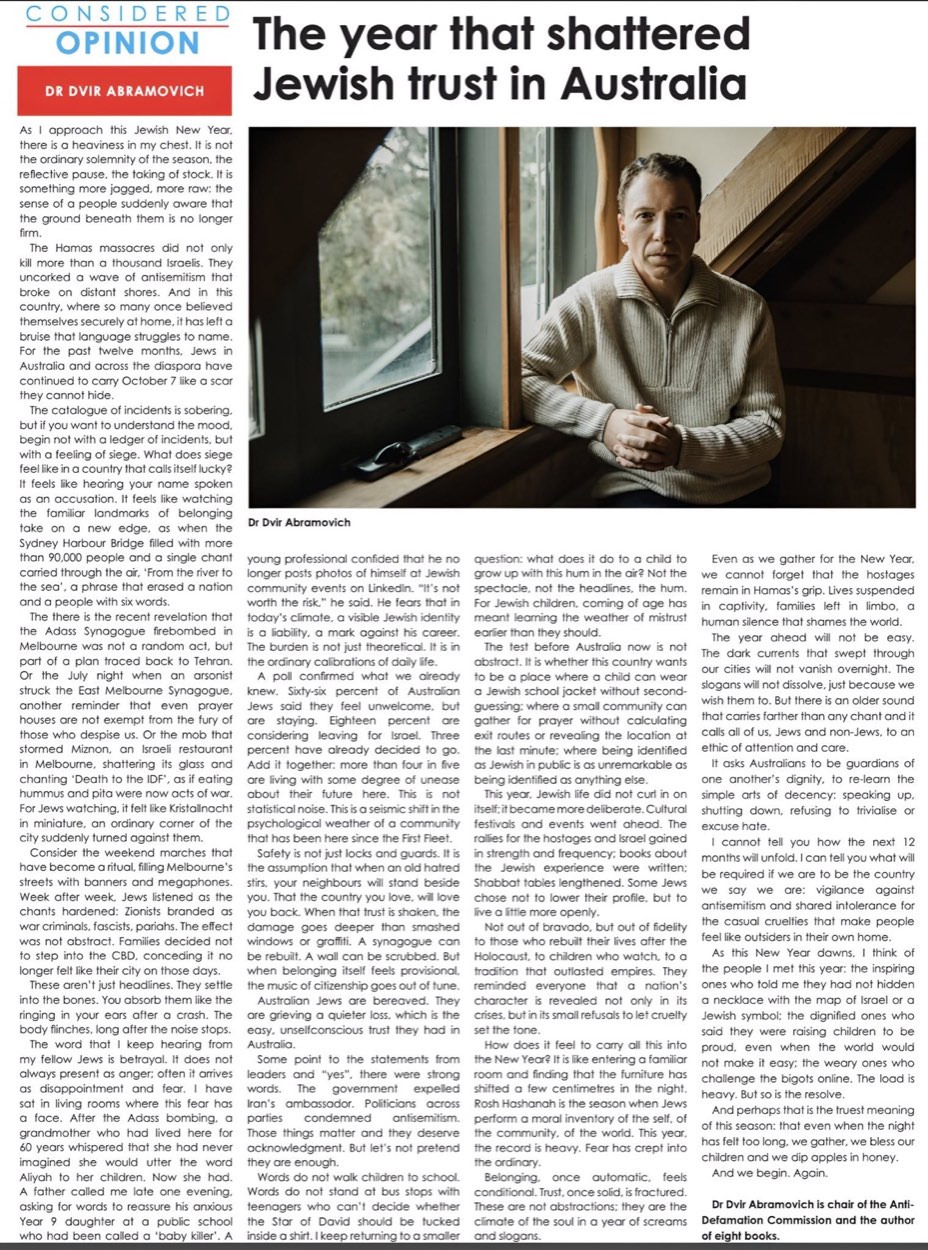
Chairman, Anti-Defamation Commission
Listen to this column 8:38 · AI narration
As I approach this Jewish New Year, there is a heaviness in my chest. It is not the ordinary solemnity of the season, the reflective pause, the taking of stock. It is something more jagged, more raw: the sense of a people suddenly aware that the ground beneath them is no longer firm.
The Hamas massacres did not only kill more than a thousand Israelis. They uncorked a wave of antisemitism that broke on distant shores. And in this country, where so many once believed themselves securely at home, it has left a bruise that language struggles to name. For the past twelve months, Jews in Australia and across the diaspora have continued to carry October 7 like a scar they cannot hide.
The catalogue of incidents is sobering, but if you want to understand the mood, begin not with a ledger of incidents, but with a feeling of siege. What does siege feel like in a country that calls itself lucky? It feels like hearing your name spoken as an accusation. It feels like watching the familiar landmarks of belonging take on a new edge, as when the Sydney Harbour Bridge filled with more than 90,000 people and a single chant carried through the air, 'From the river to the sea', a phrase that erased a nation and a people with six words.
Then there is the recent revelation that the Adass Synagogue firebombed in Melbourne was not a random act, but part of a plan traced back to Tehran. Or the July night when an arsonist struck the East Melbourne Synagogue, another reminder that even prayer houses are not exempt from the fury of those who despise us. Or the mob that stormed Miznon, an Israeli restaurant in Melbourne, shattering its glass and chanting 'Death to the IDF', as if eating hummus and pita were now acts of war. For Jews watching, it felt like Kristallnacht in miniature, an ordinary corner of the city suddenly turned against them.
Consider the weekend marches that have become a ritual, filling Melbourne's streets with banners and megaphones. Week after week, Jews listened as the chants hardened: Zionists branded as war criminals, fascists, pariahs. The effect was not abstract. Families decided not to step into the CBD, conceding it no longer felt like their city on those days.
But when belonging itself feels provisional, the music of citizenship goes out of tune.
These aren't just headlines. They settle into the bones. You absorb them like the ringing in your ears after a crash. The body flinches, long after the noise stops.
The word that I keep hearing from my fellow Jews is betrayal. It does not always present as anger; often it arrives as disappointment and fear. I have sat in living rooms where this fear has a face. After the Adass bombing, a grandmother who had lived here for 60 years whispered that she had never imagined she would utter the word Aliyah to her children. Now she had. A father called me late one evening, asking for words to reassure his anxious Year 9 daughter at a public school who had been called a 'baby killer'. A young professional confided that he no longer posts photos of himself at Jewish community events on LinkedIn. "It's not worth the risk," he said. He fears that in today's climate, a visible Jewish identity is a liability, a mark against his career. The burden is not just theoretical. It is in the ordinary calibrations of daily life.
A poll confirmed what we already knew. Sixty-six percent of Australian Jews said they feel unwelcome, but are staying. Eighteen percent are considering leaving for Israel. Three percent have already decided to go. Add it together: more than four in five are living with some degree of unease about their future here. This is not statistical noise. This is a seismic shift in the psychological weather of a community that has been here since the First Fleet.
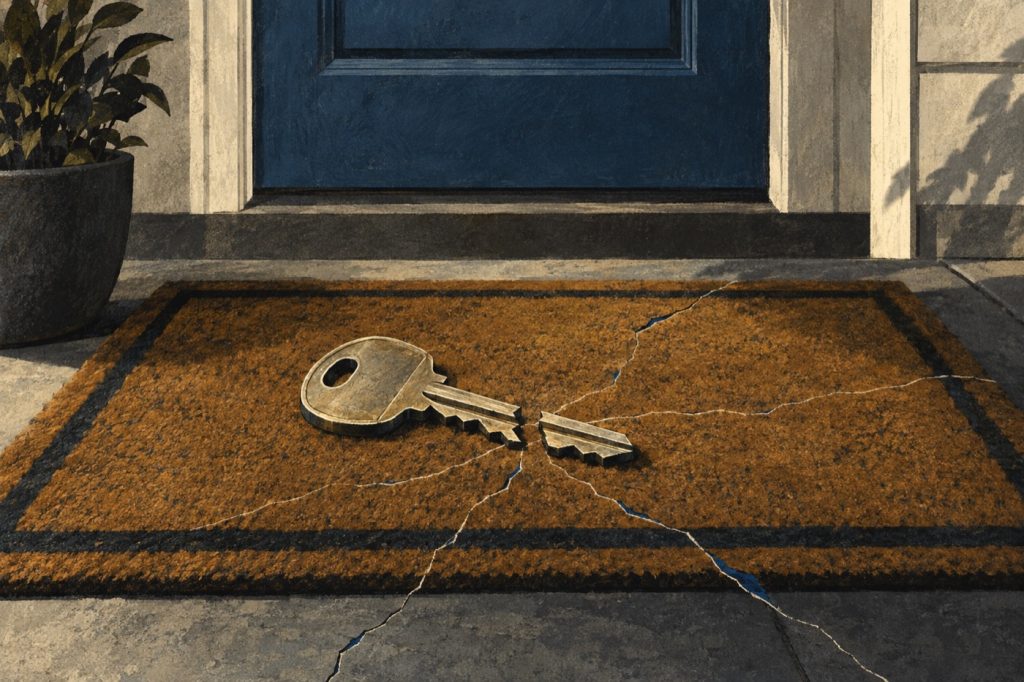
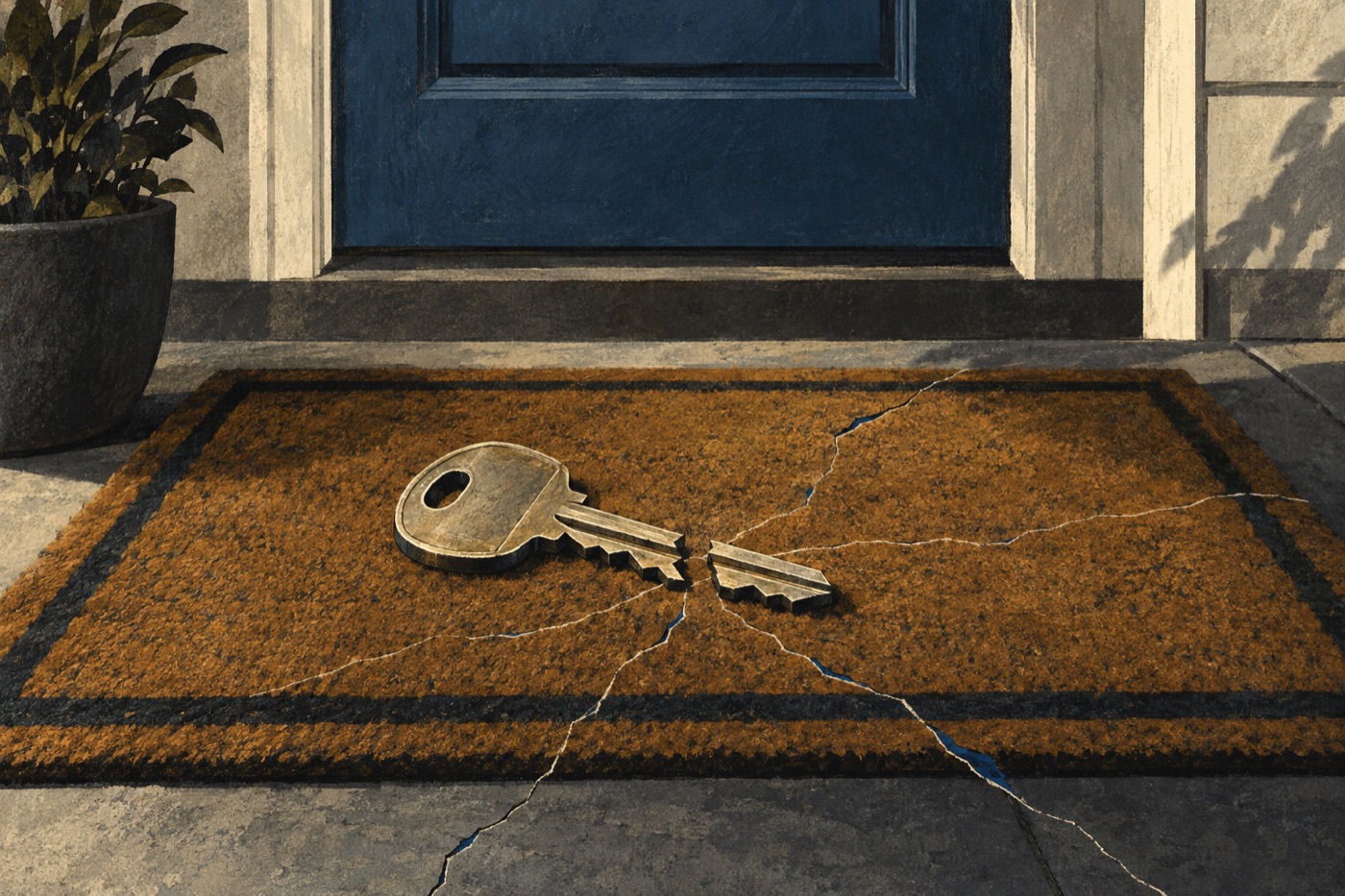
Safety is not just locks and guards. It is the assumption that when an old hatred stirs, your neighbours will stand beside you. That the country you love, will love you back. When that trust is shaken, the damage goes deeper than smashed windows or graffiti. A synagogue can be rebuilt. A wall can be scrubbed. But when belonging itself feels provisional, the music of citizenship goes out of tune.
Australian Jews are bereaved. They are grieving a quieter loss, which is the easy, unselfconscious trust they had in Australia.
Some point to the statements from leaders and "yes", there were strong words. The government expelled Iran's ambassador. Politicians across parties condemned antisemitism. Those things matter and they deserve acknowledgment. But let's not pretend they are enough.
Words do not walk children to school. Words do not stand at bus stops with teenagers who can't decide whether the Star of David should be tucked inside a shirt. I keep returning to a smaller question: what does it do to a child to grow up with this hum in the air? Not the spectacle, not the headlines, the hum. For Jewish children, coming of age has meant learning the weather of mistrust earlier than they should.
The test before Australia now is not abstract. It is whether this country wants to be a place where a child can wear a Jewish school jacket without second-guessing; where a small community can gather for prayer without calculating exit routes or revealing the location at the last minute; where being identified as Jewish in public is as unremarkable as being identified as anything else.
This year, Jewish life did not curl in on itself; it became more deliberate. Cultural festivals and events went ahead. The rallies for the hostages and Israel gained in strength and frequency; books about the Jewish experience were written; Shabbat tables lengthened. Some Jews chose not to lower their profile, but to live a little more openly.
Not out of bravado, but out of fidelity to those who rebuilt their lives after the Holocaust, to children who watch, to a tradition that outlasted empires. They reminded everyone that a nation's character is revealed not only in its crises, but in its small refusals to let cruelty set the tone.
How does it feel to carry all this into the New Year? It is like entering a familiar room and finding that the furniture has shifted a few centimetres in the night. Rosh Hashanah is the season when Jews perform a moral inventory of the self, of the community, of the world. This year, the record is heavy. Fear has crept into the ordinary.
Belonging, once automatic, feels conditional. Trust, once solid, is fractured. These are not abstractions; they are the climate of the soul in a year of screams and slogans.
Even as we gather for the New Year, we cannot forget that the hostages remain in Hamas's grip. Lives suspended in captivity, families left in limbo, a human silence that shames the world.
The year ahead will not be easy. The dark currents that swept through our cities will not vanish overnight. The slogans will not dissolve, just because we wish them to. But there is an older sound that carries farther than any chant and it calls all of us, Jews and non-Jews, to an ethic of attention and care.
It asks Australians to be guardians of one another's dignity, to re-learn the simple arts of decency: speaking up, shutting down, refusing to trivialise or excuse hate.
I cannot tell you how the next 12 months will unfold. I can tell you what will be required if we are to be the country we say we are: vigilance against antisemitism and shared intolerance for the casual cruelties that make people feel like outsiders in their own home.
As this New Year dawns, I think of the people I met this year: the inspiring ones who told me they had not hidden a necklace with the map of Israel or a Jewish symbol; the dignified ones who said they were raising children to be proud, even when the world would not make it easy; the weary ones who challenge the bigots online. The load is heavy. But so is the resolve.
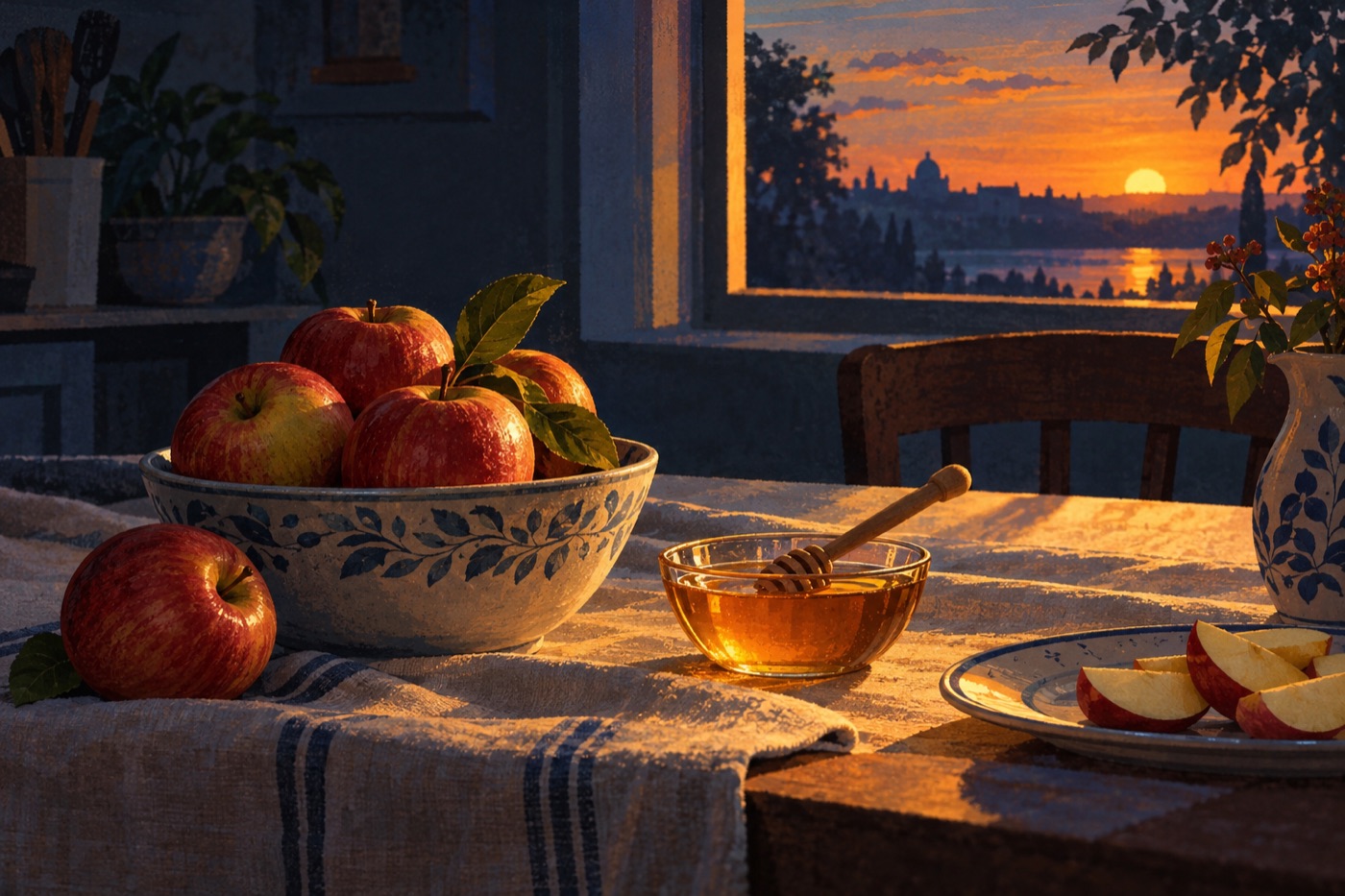
And perhaps that is the truest meaning of this season: that even when the night has felt too long, we gather, we bless our children and we dip apples in honey.
And we begin. Again.
First published in The Jewish Report, September 2025.
Dr Dvir Abramovich is chairman of the Anti-Defamation Commission and the author of nine books. His latest publication is The Heart of Amos Oz: Love, War & Grief.